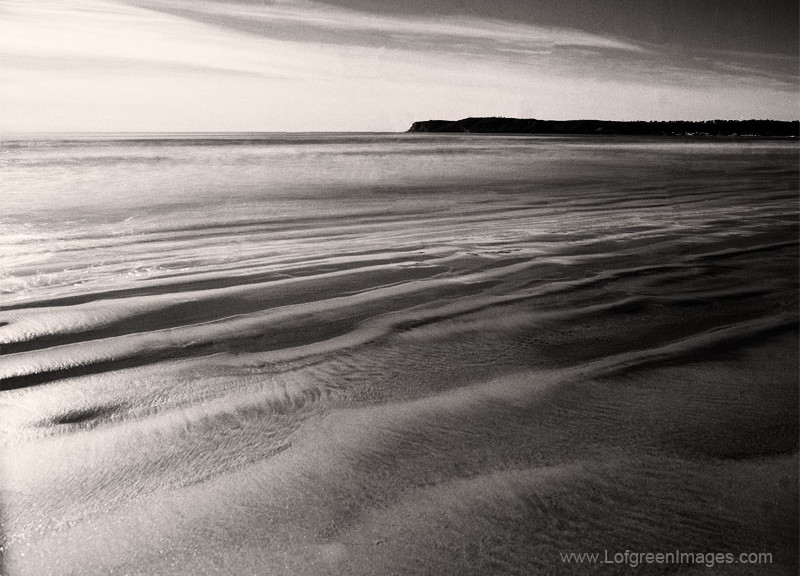
I am excited to announce that I will be having a solo show during the Louisville, CO Friday night art walk. I will be showing some of my prints at the Fuzzy Antler on Friday December 2nd. I hope you all of my readers will be able to come and hang out, drink some wine and look at some of my prints. While I was going through my images to choose the ones I will include in the show I came across an negative that I put on the back burner and then forgot about.
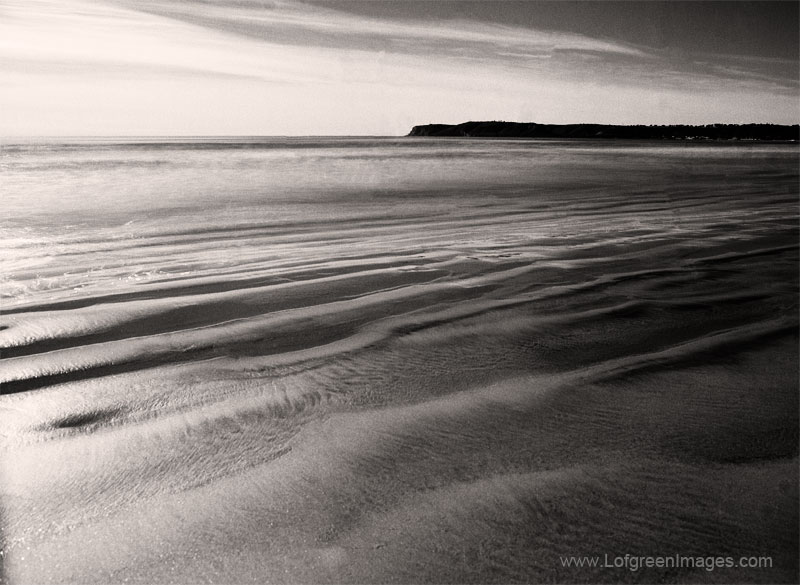
Point Loma CA on the horizon with Coronado Island beach in the foreground
The reason this image jumped out at me recently is because it is so simple. The amazing thing about black and white photography is how images get more powerful the simpler they become. When you start striping away all of the unnecessary pieces that fall into your viewfinder the more exciting it gets. Then, once you have only the pieces you want and nothing more is when that magic happens and the shutter is tripped. Stripping an image down to its bare essentials, keeping it simple, will always result in a powerful image. Give it a try.
I had a chance to burn a couple of hours and a couple of rolls of film last week. It was late in the afternoon on a Sunday and I needed to take my dog for a walk and I thought “why not take her out to Eldorado before the sun goes down?” I already had my gear all packed up from my previous trip to Arizona when I shot the SFX 200. All I needed to do was grab a couple of rolls of film, the dogs leash and we were off.
When I arrived at the canyon parking lot most of the visitors were leaving for the day. I knew that would make things easier if I wanted a shot without people in it. The sun had gone over the ridge top of the canyon and only the top 1/4 of the canyon walls really had much direct sunlight on them. That left the bottom of the canyon with wonderful soft even light blanketing the rocks and trees. “Perfect”, I thought to myself.
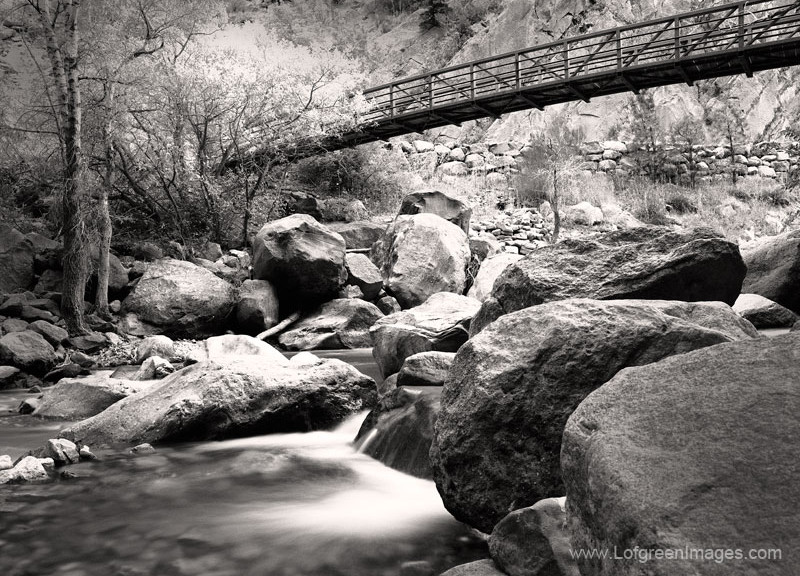
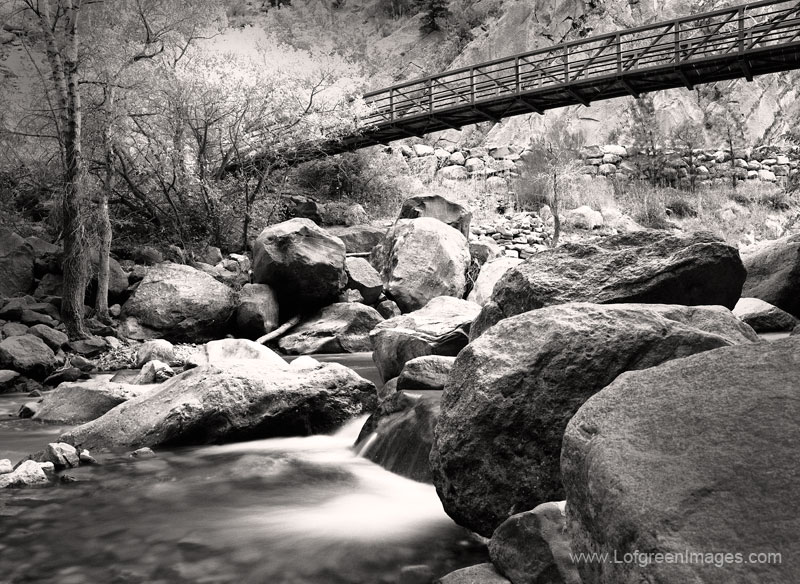
Looking up South Boulder Creek at the bridge in Eldorado Canyon. Mamiya 645, 45mm f2.8, Kodak T-Max 100, Red Filter
I was hoping to get some soft water shots of the Boulder Creek and the soft light and 100 iso film was going to work out great. I found a spot a few yards downstream from the foot bridge that had a good view upstream of the bridge. After setting up the camera and convincing my dog that this spot was a good spot to stop for a while I took a reading with my light meter. With the soft even light there was not a whole lot of contrast so I threw on a red filter to add a little pop to the negative. I dialed in the f stop at f16 and based on my meter and compensation for the red filter started to bracket at 1/2 of a second.
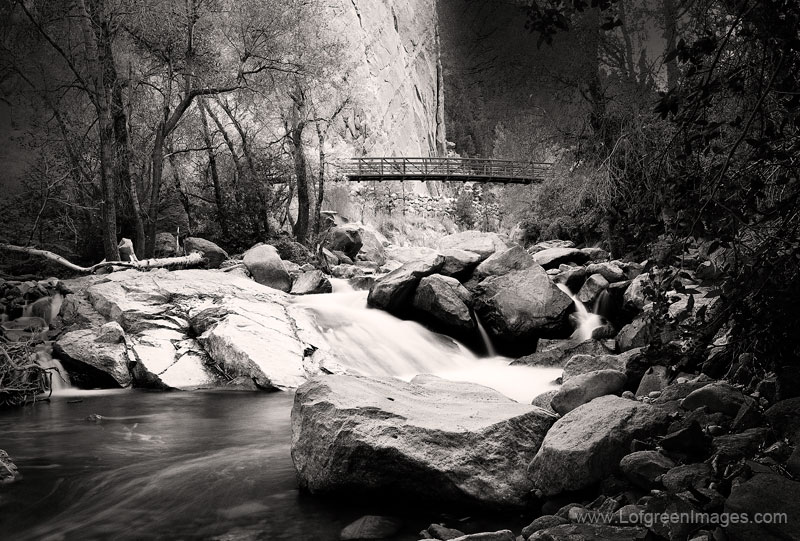
South Boulder Creek at the bridge in Eldorado Canyon. Mamiya 645, 45mm f2.8, Kodak T-Max 100, Red Filter
Once I was satisfied I had what I needed at the first stop I picked up the gear and followed my dog up the trail a to a closer vantage spot of the bridge over the creek. I pretty much repeated what I did at the first stop but had to compensate for loosing the sunlight as it kept getting darker as it set over the mountains. From there we trekked on up the creekside trail to a few other really nice spots. All in all I got a good handful of images from that little trip to walk the dog.
I have been shooting black and white film for a long time. I am most familiar with regular with films like Tri-X, T-Max, Ilford Delta films and many others like that. In all of my film shooting years I have never shot infrared film. Kodak HIE is long gone and I am kicking myself for not taking the chance to shoot with it. We still have a handful of great infrared films to use and I intend on trying them all. My first experiment with infrared film is with the Ilford SFX 200.
Ilford’s SFX film is not a true infrared film, it is much more sensitive to infrared wavelengths but it’s not truly infrared. It is supposed to be shot at 200 iso but that is if you want to have a pretty normal looking black and white image. It has some more contrast than most film at 200 ISO but nothing like an infrared image. But, Ilford calls this film Special Effects, SFX for short. So, with the extended infrared sensitivity you can achieve infrared like effects with this film!
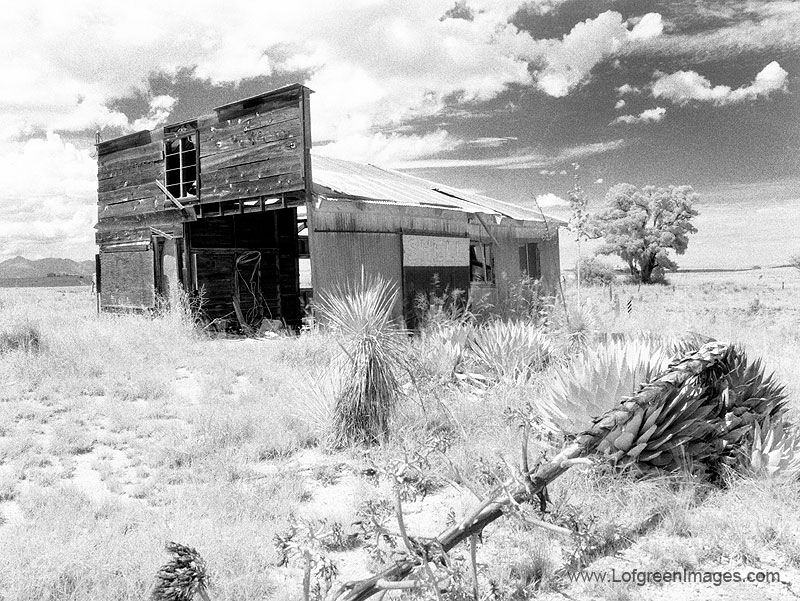
Shot with Illford SFX 200, an abandoned old time Shell gas station still stands in the high country dessert in southern Arizona.
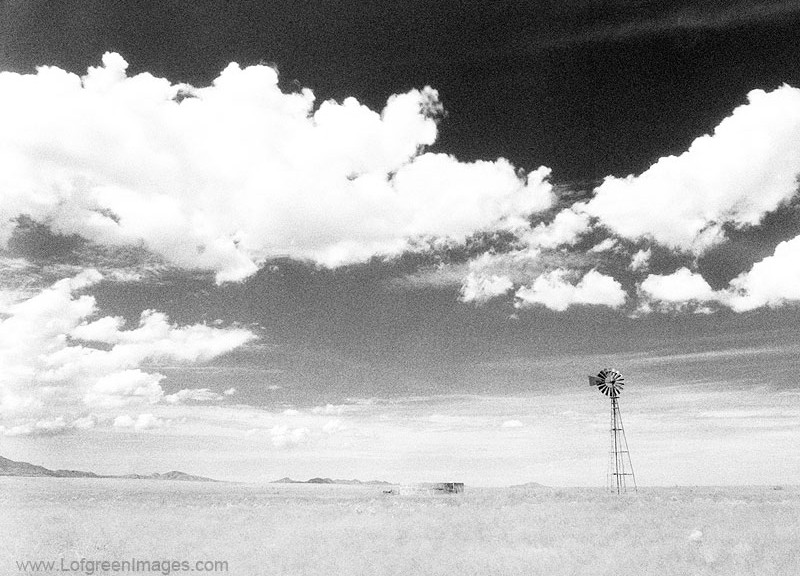
The key to getting an infrared look are two things. The first is to over expose the film. When I say over expose I mean OVER EXPOSE! Like, start shooting this stuff at 6 iso or slower. When SFX is over exposed it turns the the blue sky darker black and all of the green foliage starts to go white because of the extended infrared sensitivity. The image above was shot at mid day, at f16 for 8 seconds.
The second key to getting an infrared look with SFX is to use an infrared filter. It is like a red filter except it filters all light except the infrared wavelength to the film. I used a R72 filter on my Mamiya 645 with a wide angle lens. When you have this filter on the lens you can’t see anything in the view finder because it is so dark. I had to compose without the filter, then attach it to the lens before I made the exposure.
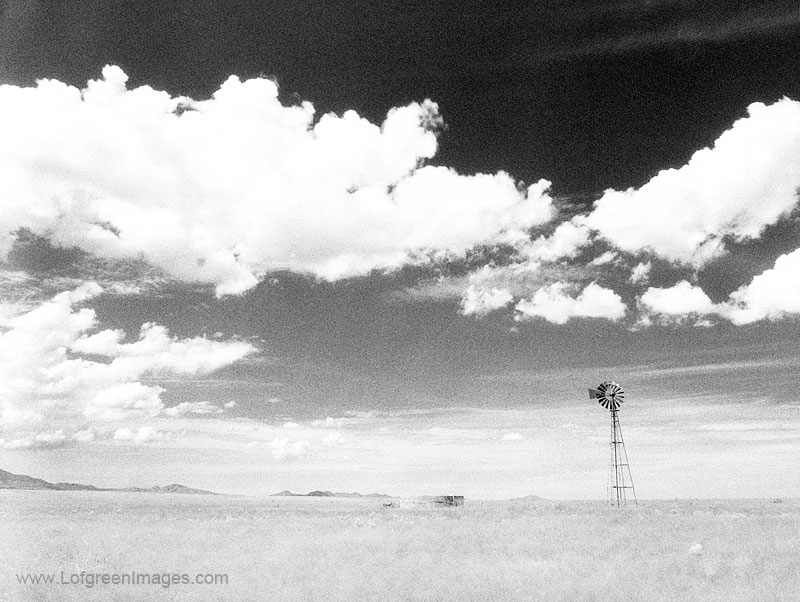
Shot with Ilford SFX 200, a windmill in the desert of Arizona pumps water for grazing cattle.
I will defiantly shoot this film again. The great thing about using this film is that it loves mid day sun. So, if you don’t have a good window of time to shoot in the early morning or late afternoon it’s a great film to use in the middle of the day when the sun is really shining. I will give it another try somewhere with very green vegetation so I can get the most out of the contrast when the greens go white.